
The story
Night in Bogotá descends with a cold that seems to chill you to the bone, transforming the imposing architecture of the fine arts university into a labyrinth of shadows and grave-like silences. For Rodrigo, the veteran night watchman on duty, the darkness wasn't simply the absence of light, but a territory inhabited by presences that refused to rest. Every shift began with the same routine: walking the endless hallways, checking the classrooms where the plaster sculptures seemed to come to life under the flickering beam of his flashlight, and securing every entrance.
Yet the laws of physics and logic would dissolve as soon as the clock struck past midnight. Rodrigo experienced this firsthand when, walking through the upper areas of the building, he would feel the brush of an icy breeze and the echo of stealthy footsteps following right behind him. When he turned his head, he could only catch sight of amorphous silhouettes, oversized shadows that glided with impossible agility along the walls, vanishing just before touching the brightness of a lightbulb.
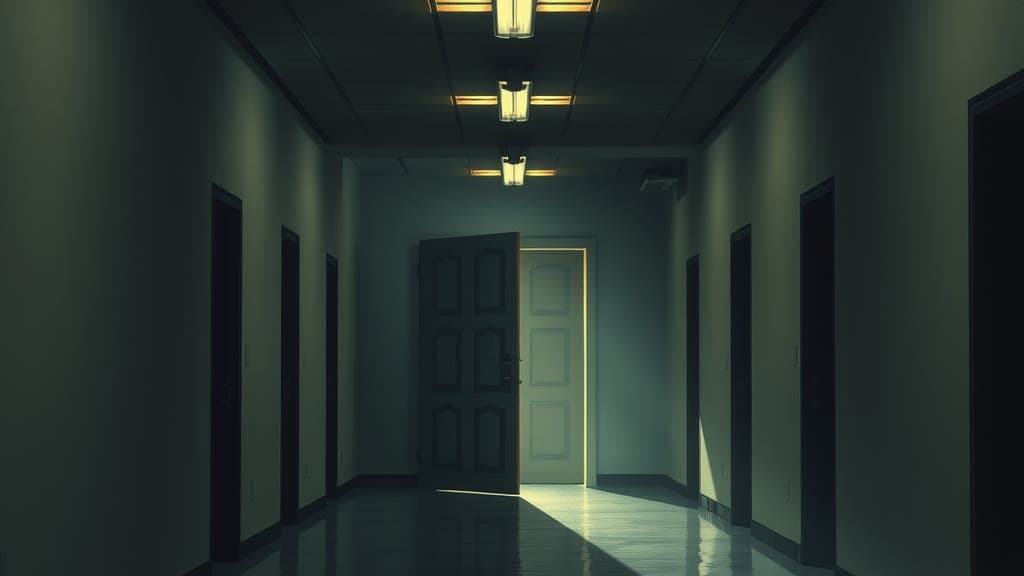
The phenomenon wasn't a solitary secret. His fellow watchmen shared the same dread. It wasn't uncommon to hear the sudden flickering of the lights in the main auditorium, a capricious electrical game that turned the fluorescent tubes on and off without a single switch being touched. But the most unsettling thing happened on the fifth floor. Up there, the doors of the workshops and storage rooms, jealously secured with heavy padlocks and double-locked at the end of the evening, would invariably be found wide open by morning, as if an invisible hand were demanding passage into the depths of repressed creativity.
The critical point of that geography of terror was concentrated near the library, a narrow hallway where the atmosphere grew dense and oppressive. Several employees, men hardened by night work, had collapsed unconscious right there, struck down by a dull panic that squeezed their chests as they felt a fixed stare on the back of their necks. Rodrigo himself experienced an icy vertigo every time his flashlight swept across the dark windows, convinced that on the other side of the glass something was watching him with malicious curiosity.
That early morning, as he patrolled the galleries with his two-way radio in hand, a draft of air blew out the only lamp within his reach. In total gloom, the watchman understood that the shadows were no longer hiding in the corners; they were marching right beside him, waiting for the exact moment the city woke up to claim their next fainting victim.


