
The story
Night hung heavy over the plains of Tolima as Carlos’s old car took the turnoff toward the cemetery grounds of Armero. The dashboard clock read just past nine. The air, thick with the lingering heat of the earth and laden with that unmistakable scent of dried mud and wild brush, seeped in through the cracked windows. They rode in silence, well aware that this place was no tourist stop, but a vast open-air altar. They had made the trip to fulfill an overdue manda, a solemn religious vow requiring them to bring light and holy water to the souls resting beneath the crust of petrified mud.
They pulled up near one of the crosses erected over the old rubble. Outside, the darkness seemed to swallow the silhouettes of the twisted trees. Carlos and his brother Fabián got out to perform the ritual, while his wife and his aunt chose to stay safe inside the car, doors locked. "We won't be long," Fabián whispered before shutting the metal door with a dull thud that echoed hollowly across the vast plains.
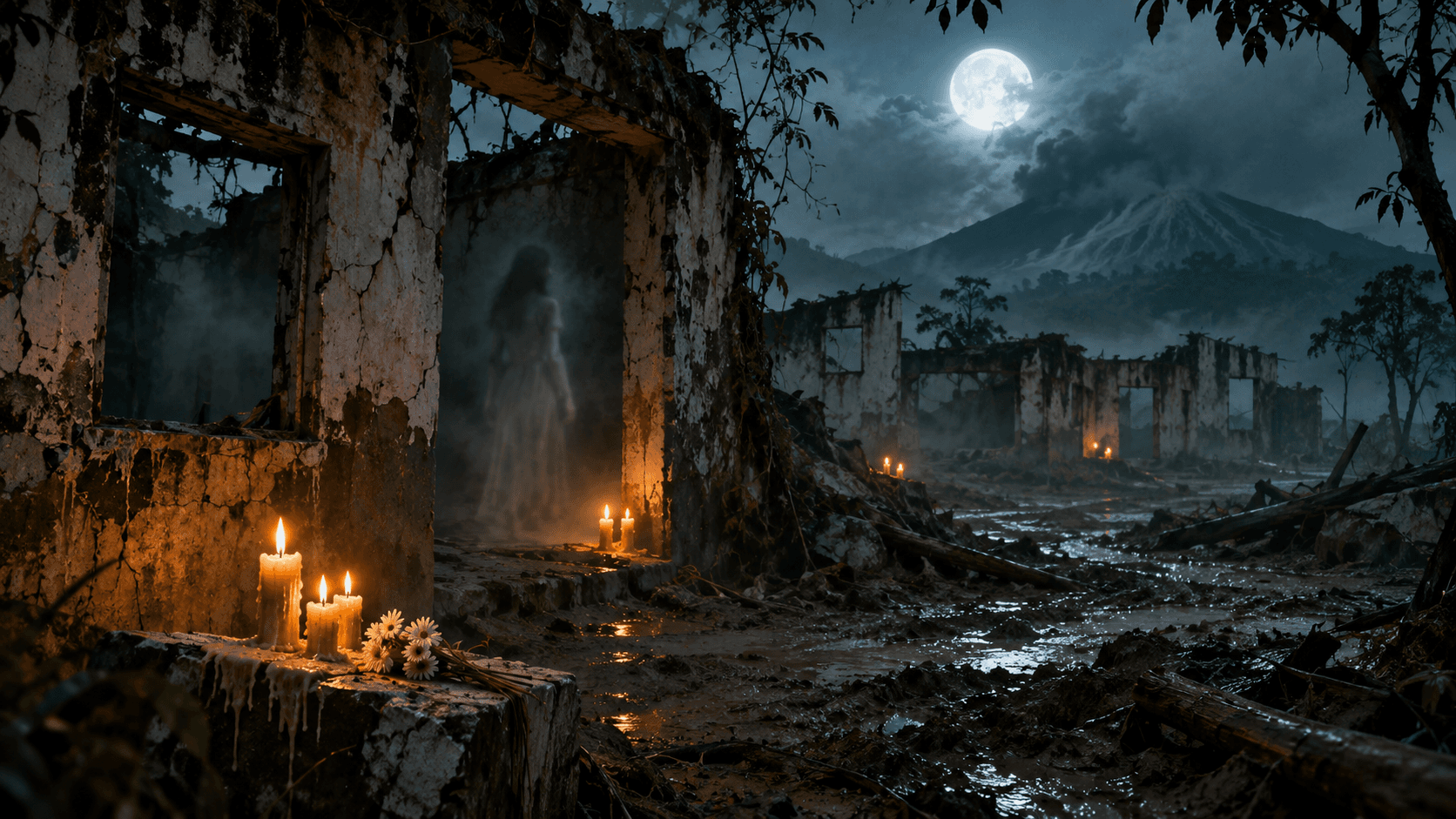
As soon as the two men walked a few paces away, tall candles and a glass bottle in hand, the car began acting up. The headlights flickered nervously, as if the battery were draining under some invisible load. The dashboard warning lights flashed on and off in a frantic code. Inside, the two women gripped their seats, seized by a sudden, bone-chilling cold. They peered through the fogged-up windshield, and what they saw froze their blood: a crowd of silent shadows—figures of men and women crouched patiently in circles around the car and the grave, lighting tiny yellow flames on the ground.
Just steps away, completely oblivious to the panic consuming the car, Carlos knelt before the slab. The match struck against the strip with a clean crackle. The flame caught smoothly and stood tall, defying the breeze. He and his brother devoutly recited the Our Fathers, sprinkled the water in the sign of the cross, and watched the gentle glow flicker against the stone. Around them, everything was dead calm; they didn't hear strange noises, footsteps, or the slightest hint of danger. There was only the thick stillness of midnight.
Having finished their prayers, they walked calmly back to the car. When they opened the door, the collision of realities was jarring. They found the two women pale and distraught, choking back tears and trembling from head to toe. With a voice strangled by terror, the aunt practically screamed at them, asking why they had taken so long among all those strangers, and where that crowd sitting around lighting candles with them had come from. Carlos and Fabián exchanged baffled looks. Turning to look over their shoulders, the field was swallowed in pitch darkness—only the two candles they had just lit flickered there. There had never been anyone else.
Across those lands of Tolima, though, echoes of the past have a way of bleeding through without warning. Locals know all too well that time there got trapped in an endless loop. They say, for instance, that some time ago a group of visitors spotted a campesino, a rural countryman, riding a bicycle along a rocky trocha, a rough dirt track, in broad daylight. The man pedaled at a monotonous rhythm, eyes fixed straight ahead, his shirt frayed and coated in dust. Though the onlookers whistled and waved a friendly hello, the figure rode on without blinking or turning his head, vanishing around a dry bend like an echo locked in a daily routine from decades ago.
It is the same along the edges of the highway that skirts the old town, where shadows still try to carry out their former trades. People recall the driver whose truck broke down in the dead of night from a blown-out tire. Desperate in the roadside solitude, he saw a man step out of the brush dressed in dark mechanic's overalls, carrying a heavy flashlight. Sparing with words and making precise gestures, the man signaled him to wait a moment and headed into the thick trees to fetch his tools.
After waiting a long time with no sign of help, the driver decided to follow the mechanic's trail, cautiously picking his way through the brush. The darkness was absolute, pierced only by the unsteady beam of his phone. He walked about thirty yards until he ran right into an old, cracked concrete wall—the only standing wall left of a building swallowed by the disaster. Across the peeling surface, you could barely make out a faded sign for a montallantas, a roadside tire repair shop, that had vanished decades ago. At the base of the wall, abandoned in the mud and overgrown weeds, lay the flashlight, still on, shining into nothingness.


