
The story
At the edge where the village started giving way to the thick Andean forest, Mateo ran a small grocery store that operated out of the front part of his house. It was an old building with packed-earth walls and a worn concrete floor, cooled by the humid breeze coming down from the nearby creek. During the day, the shop smelled of freshly roasted coffee, panela, and tobacco; but as evening fell, when the surrounding vegetation seemed to swallow the last rays of the sun, the atmosphere took on a dense heaviness, almost palpable.
It all started with little things that Mateo chalked up to tiredness or carelessness: the counter keys would turn up inside the sacks of corn, the scissors would end up on top of the soda cooler, and the change coins would roll across the floor all by themselves. Yet as the weeks went by, the weird occurrences grew disconcertingly bold. In the middle of the dawn, the old stereo system would turn on at full blast, flooding the house with bursts of static and distorted melodies, only to cut out abruptly the moment Mateo stepped onto the hallway. The lightbulbs flickered with an electric whim, and the heavy wooden doors would slam shut all at once, as if pushed by a dry wind that didn't exist outside.
The two mutt dogs that slept in the patio were the first to be unsettled by the presence. On certain nights, they would fix their gaze on the darkest corners of the store, raise the fur on their backs, and break the silence with a pitiful, prolonged howl—a deep lament that they never directed at the travelers from the vereda, the rural neighborhood. Mateo tried to calm himself down, but one afternoon, while sweeping alone after pulling down the metal security gate, a clear and subtle whisper blew his very name straight into his ear: "Mateo." When he whipped around with his heart in his throat, the hallway's gloom was completely empty.
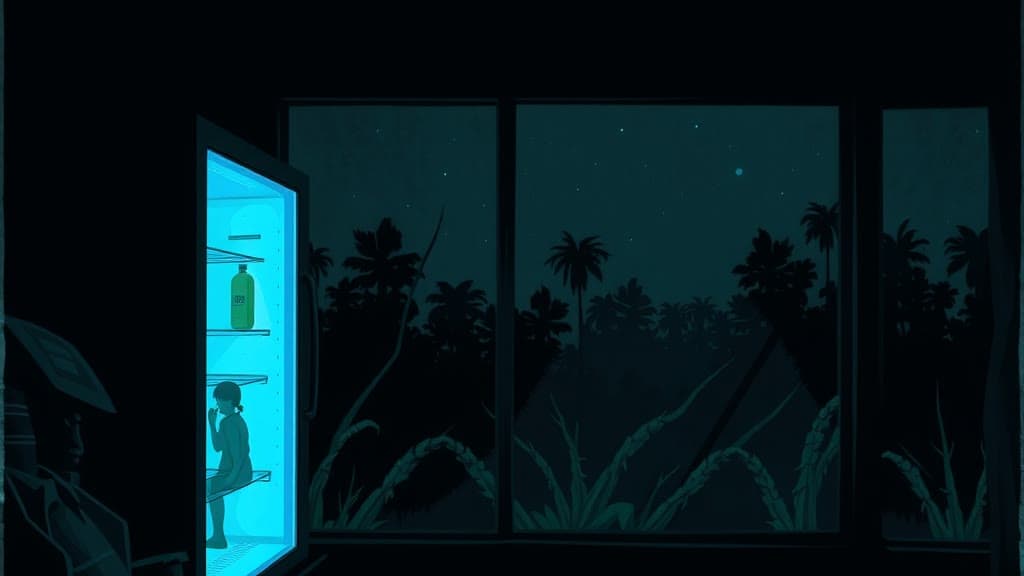
The certainty that an entity shared his roof arrived on a Friday evening. His compadre Julián, his close friend, had stopped in front of the refrigerated display case to grab a drink. Suddenly, the man froze, his hand locked onto the metal handle. In the reflection of the glass lit up by the fluorescent tubes, he clearly saw a small shadow, barely a meter tall, standing right behind him. It looked like the hunched, attentive silhouette of a tiny creature watching him with insolent curiosity.
Julián spun around sharply, but there was no one there—only the plastic curtain of the patio swaying to the rhythm of an ice-cold gust.
Ever since then, Mateo learned to live with the unease of not being the only owner of the place. Some people in town suggested it was the wandering soul of some child lost in remote times; others, more accustomed to the mysteries of the mountain range, assured him it was a duende del monte, a woodland sprite, a mischievous spirit that found a new game among the shelves, lightbulbs, and loneliness to shake off its boredom.


