
The story
María grew up listening to the rustle of the savanna beneath her feet and the distant rumor that the townspeople called Cielo Rojo. Since childhood, the silhouette of the finca, a small country farm, stood out against the horizon like a scar in the infinite green of the llanos, the vast tropical plains. The orange and mango trees, still heavy with fruit, clung to the sterile earth, and an atmosphere of abandonment could be breathed in every breeze that slipped between their branches.
When she reached adolescence, the elders of the town surrounded her with warnings as firm as the beat of a festival drum: "Don't even think about it, child, that land is cursed. Don't enter, don't get close, there is no return from there." The words were repeated at market gatherings, in chats under the shade of the guadua, a tall, bamboo-like grass, and in the whispers of the old folks while the sun hid behind the ridge. María learned to respect that invisible limit, though curiosity bit her like a nighttime mosquito.
As time went by, the community began to use the finca as a dumping ground for the bodies of animals that had been hit by the road in the area. The villagers, fearful of the stench that accumulated along the paths, threw the carcasses among the bushes and fallen logs, as if the black earth could absorb the guilt and the smell. Every morning, the scent of decomposing flesh mixed with the sweet perfume of the citrus, creating a blend that made the chest of anyone passing nearby tremble.
It wasn't long before the elders of the town began to lose their calm. Late at night, invisible whispers slipped through the cracks of the houses, calling them by name, preventing them from falling asleep. The voices seemed to come from the finca itself, as if the wind had learned to speak in a tone of lament. The old folks, with glazed eyes, began to wander the street, murmuring incomprehensible words, as if an ancestral song were dragging them into the darkness.
With the madness came the strangest symptoms: a thick substance, resembling pus, broke out on the skin of those affected, forming irregular and painful sores. The town doctors, accustomed to the problems of the savanna, could not explain that condition. They prescribed herbs and ointments, but the skin kept bleeding, and every dawn the pain intensified, as if the earth itself wanted to devour them from within.
The sick, consumed by the sores, began to die in agonizing ways. Their screams echoed in the night, breaking the silence of the plain. They cried out for help, while sweat ran down their foreheads and blood mixed with the damp earth beneath their feet. The families, with their hearts in their mouths, watched as their loved ones faded away in the dawn mist, unable to do anything other than observe the horror.
The police, upon receiving calls for help, rushed to the scene with trembling flashlights and crackling radios. They tried to calm the neighbors, but upon crossing the road leading to the finca, an inexplicable pressure enveloped them. The air became heavy, almost impossible to breathe, and the light of their lanterns seemed to go out on its own. The officers returned to the police station courtyard with pale faces and lost gazes, while the villagers, upon seeing the scene, ran out into the street, trembling and breathless, as if a shadow had chased them.
Those who tried to build homes near Cielo Rojo soon abandoned their half-finished work. Hammers fell inert, unpainted walls remained open to the wind. Each day at dawn, the air felt heavier, as if an invisible layer of fog carried an impossible weight to describe. The workers, feeling sweat soak their foreheads for no reason, dropped their tools and fled, leaving the land like a field of rubble with no future.
A group of young people, driven by curiosity and defiance, decided to burn the finca to end the curse that had taken root in the place. They lit a bonfire around the perimeter, but the fire, instead of devouring the main structure, spread like a snake surrounding the trees without touching the central trunk. The flames danced in the air, illuminating the shadows of the mango trees, but the main house remained intact, as if protected by a force no one could see.
Thus, the finca continued to look abandoned, but with lush vegetation that contrasted with the desolation of the rest of the plain. The orange and mango trees, laden with juicy fruits, swayed under the sun as mute witnesses to a secret that no one dared to reveal. The area was off-limits to anyone, and the town children played at a distance, casting frightened glances at the green contour that seemed to whisper promises and warnings at the same time.
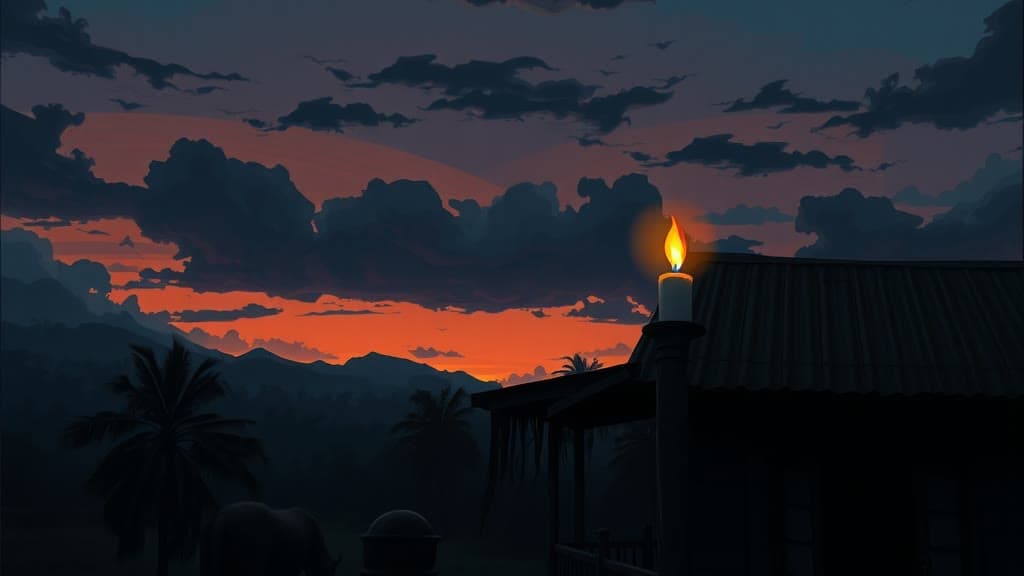
A strange custom became part of local folklore: every thirteenth of the month, a lit candle appeared inside the finca, as if an invisible hand placed it in the middle of the gloom. No one had seen the person who left it, but its flickering flame was enough for the townspeople to whisper that time itself was marked by the presence of the place. The candle never went out, even when the wind blew hard; its light was constant, like a watchful eye observing the plains.
One night, a homeless man named Julián was chased by a cat with intense red eyes. The feline, as black as night, emerged from among the bushes and lunged at him with supernatural speed. Julián ran, feeling the animal's breath on his neck, and in his desperation, he tripped over a root protruding from the ground. When the cat stopped in front of him, its eyes glowed like embers, and a voice whispered incomprehensible words that seemed to promise him something.
The next day, Julián woke up with a wad of bills in his hand and a wallet full of cash he had never possessed. The news spread like wildfire on the savanna: the homeless man had become rich overnight. However, fifteen days later, he disappeared without a trace, as if the earth had claimed him. The neighbors, fearful, began to murmur that the red-eyed cat was the guard of the finca, an emissary of the pacts woven under the moon.
The rumors spread quickly through the region. People spoke of those who, upon reaching adulthood, had sought prosperity by making dark pacts that required sacrificing cattle or pigs every thirteenth of the month. The meat, they said, was offered in rituals where names and petitions were recited, as if the plain itself listened to and answered human desires. Those who accepted the deal returned to their homes with bags of money, but the shadow of Cielo Rojo always followed them, reminding them of the price of their ambition.
María, now an adult, remembered each of those nights with a shiver running down her spine. She knew that the finca, with its lush vegetation and eternal candle, was still there, like a hidden heartbeat beneath the savanna. Every thirteenth, passing by the road bordering the field, she looked at the silhouette of the trees and wondered how many more souls had surrendered their blood to the ground so that a flickering light would keep burning in the darkness. The terror she felt was not just because of the stories, but because of the certainty that, in some corner of the llanos, the shadow of Cielo Rojo waited, ready to collect its next debt.


