
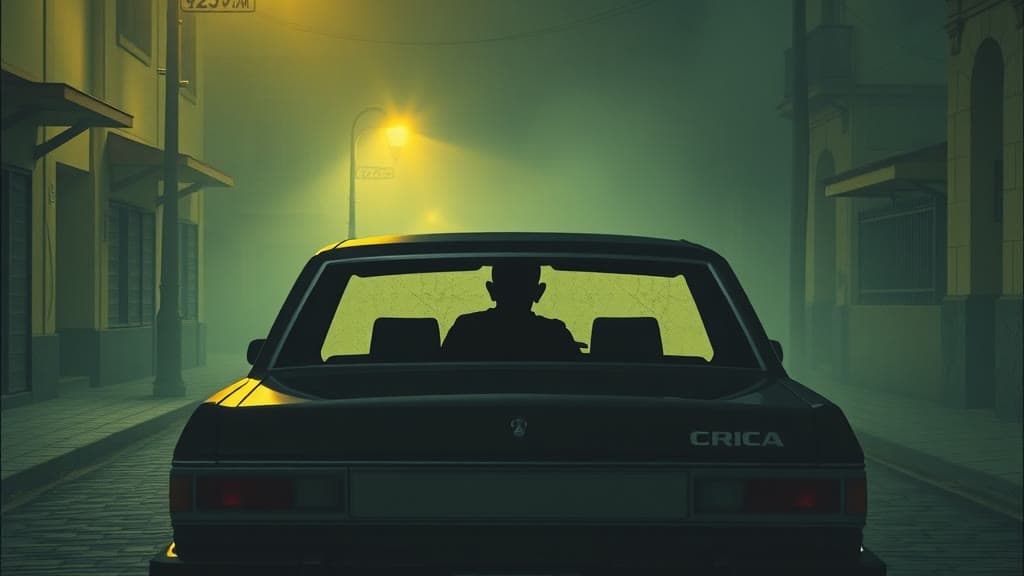
The story
That young man was barely twenty when he decided to try his hand at the demanding trade of driving through the cold, foggy streets of the Bogotá savanna. Back then, with more enthusiasm than cash in his pockets, he managed to buy an old 1984 Dacia taxi. He had bought it from a man in the Suba district, an individual with a shifty look who, upon handing over the keys and taking the cash, dropped a vague warning about the strange incidents former drivers had experienced behind the wheel of that very car. The young man, with the arrogance typical of his age and the urgency to bring home a living, dismissed the remark as a mere sales pitch used to justify the worn-out bodywork.
However, the warnings soon manifested with chilling harshness. After just a few weeks of working night shifts, the young man began to sense an invisible yet heavy presence inside the cabin. At dark street corners, while waiting for the traffic light to turn green, he clearly felt someone staring fixedly at him through the rearview window, an icy breath brushing the back of his neck even though there was no one else in the car. Often, upon turning on the interior light, he noticed subtle movements in the backseats, as if an invisible bulk were shifting around in a capricious way.
One thick, foggy afternoon, he picked up a man whose vehicle had broken down on the highway. The subject, visibly shaken and with urgency written all over his face, asked to be driven to Subachoque, offering forty thousand pesos for the fare. Once they were on their way, the passenger rolled a handcrafted cigarette containing a substance with a sweet, pungent odor, which he began smoking inside the taxi, filling the cramped space with a dense smoke that deeply annoyed the driver. Out of the corner of his eye, the cab driver noticed something terrifying: a blackish stain had formed on the Dacia's fabric ceiling, a stain that seemed to pulse and exude a darkness so dense it contrasted in a macabre way with the worn upholstery.
The unusual part wasn't just the stain, but the engine's impossible behavior. On several occasions, the engine's safety bolt came completely loose, a mechanical failure that should have stopped the vehicle immediately and for good. Yet, driven by an inexplicable force, the Dacia kept rolling smoothly along the dusty road. Furthermore, a disconcerting phenomenon occurred: the car would wake up completely covered in mud and dust after a rainy night, but at the break of dawn, without anyone having taken it to a car wash, it would appear shiny and clean, as if an invisible hand took pains to polish away its sins.
On the way back with the passenger from Subachoque, the atmosphere inside the car changed drastically. The man stopped smoking the herb and began to exhale a thick white vapor from his mouth, resembling the chemical smoke of bazuco, a cheap and toxic cocaine paste. His eyes, previously dull, underwent a disturbing metamorphosis; his pupils dilated completely and the individual fell into a deep trance. Without a word, he stretched out his arm, firmly took the driver's left hand, and guided it with superhuman force through the dark dirt tracks leading to the neighboring municipality.
The taxi came to a sudden halt in front of an abandoned colonial mansion, eaten away by time and humidity. At that moment, a blast of arctic air invaded the inside of the car, freezing the occupants' breath. Time, inexplicably, seemed to fracture and stop. The young cab driver felt his tongue strangely thickened, heavy as lead, and he completely lost control of his body; he couldn't move his eyelids, nor turn his neck, nor take his hands off the steering wheel. In the middle of that paralyzing terror, his ears filled with shrill metallic noises, as if a thousand invisible gears were violently crashing around him, and he watched in horror as a plastic bag floated statically in the air, defying gravity.
That was when the black stain on the ceiling came to life. It detached itself from the fabric like a three-dimensional, hostile silhouette, lunging brutally onto the chest of the trance-bound passenger, pinning him against the seatback with a dull violence. The driver, trapped inside his own paralyzed body, experienced a panic so pure and primitive that he felt his heart stop. That entity didn't just inhabit the car; it seemed to feed on fear.
Months later, after trying to continue his work in the Bogotá metropolitan area, the phenomenon repeated itself in another equally disturbing form. On a cold dawn at the bus terminal, he picked up a humble-looking passenger: a mute, extremely thin man, wearing the traditional ruana, a heavy woolen poncho worn by Colombian highlanders, who asked to go to the La Roca neighborhood. Halfway through the trip, the Dacia's electrical system collapsed; the headlights and dashboard went completely dark, leaving them in the pitch dark on a desolate road. Immediately, the black shadow reappeared, sliding with macabre agility from the ceiling into the car's trunk.
Upon finally reaching the destination in La Roca, the mute passenger placed his heavy hand on the driver's shoulder, opened the door, and once again, the world seemed to freeze. The deafening sound of metal parts scraping against empty space enveloped the scene as the young driver struggled to catch his breath.
That old 1984 Dacia wasn't just an economical means of transportation; it was a cursed metal trap. The young man understood, with a mix of resignation and chills, that the vehicle was possessed by the wandering, rancorous spirit of some former driver who had lost his life right there in those seats, condemned to eternally repeat the routes of Cundinamarca and drag innocent people down into the abyss of the unknown.


