
The story
Claudia had learned to see beyond the visible ever since she was a curious child wandering the neighborhoods of the capital. As the years went by, the inner murmurs turned into certainties, and she accepted the title people whispered to her: vidente y médium. There was no doubt her gift walked with her at every step, even in the most ordinary moments.
Three years ago, fate tested her in a way she could never have imagined. Her son, Mateo, barely ten, suffered an accident while playing on the ciclovía, a bike path, in the city. A violent impact knocked him unconscious, and doctors rushed him to the Hospital Universitario in the north of Bogotá. After stabilizing him, they told her he needed a CT scan to check for possible internal injuries. The scan unit was located in the building’s basements, a maze of narrow corridors, flickering lights, and a dampness that hung in the air like a tired breath.
Claudia escorted Mateo to the entrance, but the nursing staff, with weary faces and monotone voices, told her she could not go inside. “It’s not safe for you to accompany him, señora. The procedure is delicate and requires silence,” they said. The prohibition was clear: she had to wait outside, in a hallway that felt like a dead‑end tunnel. The beeping monitors, the hum of the MRI machine, and the faint drip of a pipe reminded her that time was ticking.
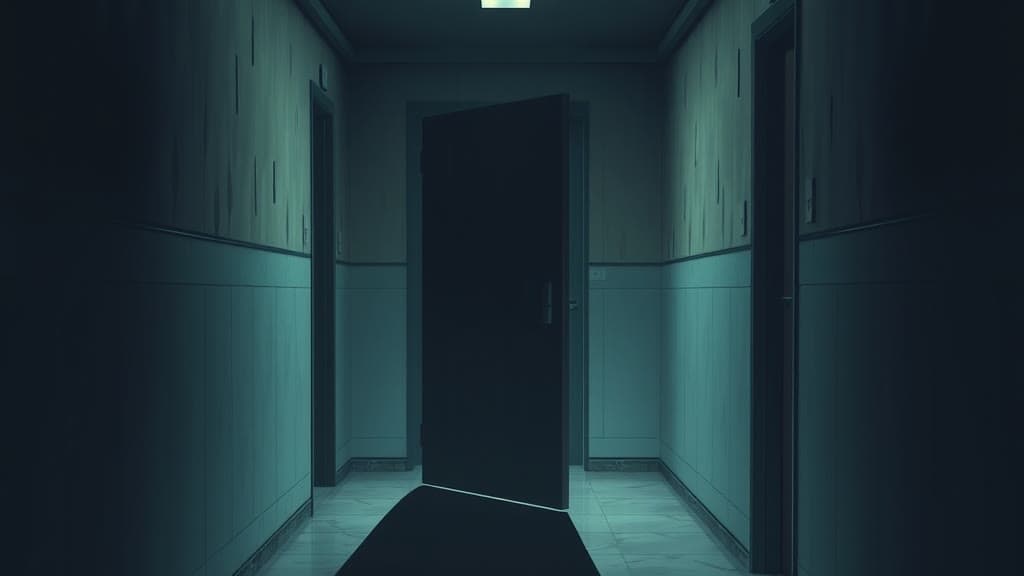
The transfers for the scan always took place between two‑thirty and three in the morning, when the city lay in an almost tomb‑like silence. That night, a blanket of fog had settled over the city, and the basement corridor was dark, damp, and eerie. Fluorescent lights flickered intermittently, casting shadows that seemed to dance to the rhythm of the electric current. The smell of chlorine and disinfectant mixed with the floor’s moisture, creating an atmosphere that tightened any visitor’s chest.
Claudia, her trembling hand pressed against the cold wall, heard the dull thud of the gurney pulling away with Mateo inside the scan room. When the door shut, she was left alone in the hallway, no other human in sight. Her own footsteps echoed like a distant drum. Suddenly, a small restroom door on her right was ajar. A narrow crack revealed the darkness inside, as if a fissure in reality had opened.
In that instant, a deep, inhuman male voice rose from the doorway’s gap. “Claudia, come here… come…,” the voice whispered, as if floating between the walls. The entity showed no body; only its sound, loaded with a strange resonance, slipped into the humid air. It didn’t say her name, but the call was aimed at her with a precision that chilled her blood. A shiver ran down her spine and a wave of fear wrapped around her like a shadow.
Despite the terror gripping her, Claudia refused to let uncertainty trap her. Fixing her eyes on the door, she asked aloud, “What do you want? Why are you calling me?” The answer came quickly, but the voice didn’t calm; instead it grew more urgent, repeating, “Come closer… come closer…,” over and over, as if the door itself were a conduit demanding her presence.
Claudia’s heart hammered, and the feeling of being watched by something invisible made her tremble. She then remembered a practice her grandmother had taught her as a child: invoking Jesus of Nazareth with faith and firmness to protect herself from any presence. Without hesitation, she closed her eyes, breathed deeply, and, in a clear voice, said three times, “Jesús, Jesús, Jesús, en tu nombre te mando que te alejes de mí.” Each invocation carried the weight of her belief, and the energy of her faith rang through the hallway like a war drum.
At the third call, the voice faded like smoke on the wind. The restroom door fell silent again, and the dim hallway lamp became her only companion. Claudia felt the pressure that had been crushing her melt away, replaced by a strange calm. The bodiless entity had dissipated before the force of the faith she had summoned.
In the moments that followed, Claudia considered approaching the young orderly who had taken Mateo, named Andrés, to ask if he had sensed anything odd. Yet she recalled he was in the middle of his night shift, overloaded with patients and mentally exhausted from the workload. She didn’t want to alarm him or add weight to his already heavy night, so she kept the incident to herself, a secret known only to the darkness.
When she emerged from the basement, the faint lobby light restored a sense of normalcy, but the experience stayed etched in her memory. As she walked toward the waiting room, she reflected on the nature of places that house pain and suffering. Hospitals, cemeteries, and lonely streets, she thought, are reservoirs of residual energy, memories of anguish that cling to walls and corners. Every scream, every sigh, every tear shed there leaves a mark that, under certain circumstances, can resonate again.
Days after the incident, Claudia attended a meeting with other people who also claimed psychic abilities. In that conversation she revealed that her gift wasn’t limited to hearing voices in the dark; she could also undertake astral travels and see real‑time visualizations of people far away. She recounted, with the serenity of someone who knows her own power, that one night she had watched, from her own body, a prisoner in a southern city jail bathing under a light that flashed on his back like an aurora. The vision was so clear she could describe the water’s color, the sound of the jet, and the man’s relieved expression as the current washed over him.
That story, though astonishing, was met with a mix of awe and skepticism. Claudia, however, wasn’t seeking anyone’s approval. For her, the ability to observe from a distance was a natural extension of her sensitivity, a way to be present in places where suffering manifested, even if only through an invisible window.
As time passed, the basement voice became a memory Claudia kept as a warning. Every dawn, when the hospital sank into silence, she recalled the ajar door and the entity’s insistence. She knew that at any moment other voices might try to cross the threshold, but she also knew that faith, intention, and clear purpose were powerful weapons against the unknown.
Thus Claudia’s life continued its course, between medical appointments, energy‑therapy sessions, and constant vigilance over the spots where pain had become trapped. Her son Mateo, after the scan and several weeks of recovery, returned to playing on the ciclovía, always under his mother’s watchful eye, who had learned that protection can take many forms, from the warmest hug to a firm invocation in the darkness.
In the hospital’s corridors, the early‑morning light still flickers, and the restroom door remains closed, as if guarding the secret of that gloomy night. But for Claudia, the memory of the voice that called her is a sign that the world is full of invisible layers, and that with faith and respect one can pass through them without getting lost in the shadow.
Claudia’s story is not just a tale of fear; it is also a reflection on the energy spaces accumulate and how sensitive beings can interact with it. Every step she takes down life’s hallways bears the mark of the seen and the unseen, reminding her that, even when darkness whispers, there is always a light that can disperse it.


