
The story
Carlos Méndez, a Navy veteran, still vividly remembered the first night terror seeped through the bricks of the battalion on the Atlantic coast. He shared the small concrete room with two officers, the sound of fans, and the faint hum of a fluorescent lamp that marked the rhythm of the guard duty. That early morning, the temperature had dropped unexpectedly, and the air grew heavy, as if the sea humidity had condensed into a thick fog inside the room.
Carlos had fallen asleep on his bunk, his body exhausted after a day of drills. Suddenly, a crushing pressure settled on his back, so strong that he felt his ribs compressing like branches under the weight of a tree. He couldn't inhale; his throat tightened, and his scream remained trapped in his chest. With his eyes half-open, he tried to move his fingers, but the weight held him motionless.
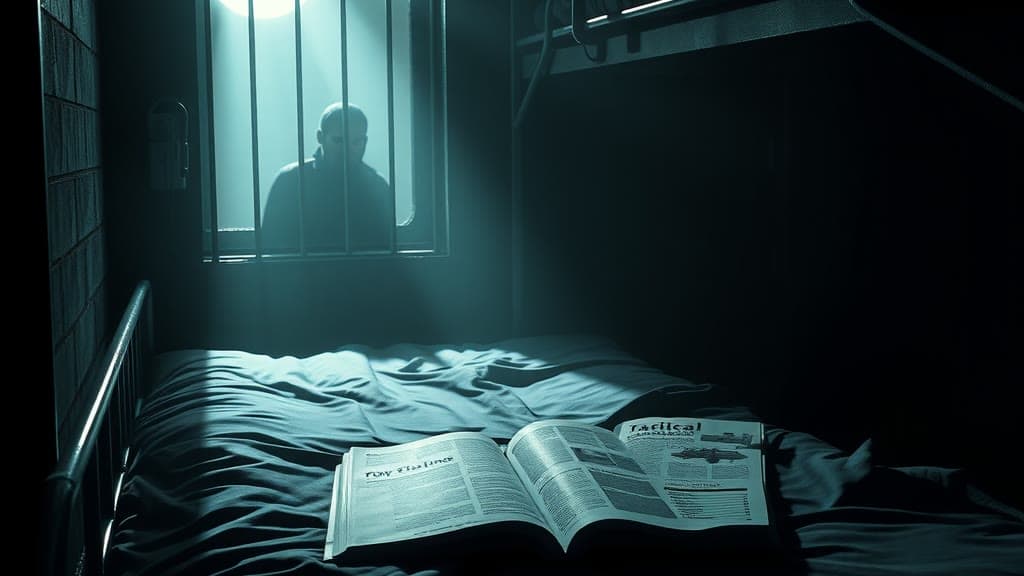
He glanced sideways at the small digital clock hanging beside the bed. The numbers flickered in red: twenty minutes until midnight. A whisper of fear crossed his mind, but before he could react, a black silhouette emerged at the edge of the light. It was a dark, featureless figure sitting in an improvised chair in front of the clock, and its hands—pale as wax—were slowly turning the pages of a military instruction manual. Each page creaked with a sound that resonated like a heartbeat under the silence of the barracks.
Carlos's body trembled with the desperation of someone fighting a shadow. With a superhuman effort, he managed to turn his head, loosen his muscles, and sit up on the bunk, as if the simple act of changing position were enough to break the spell. As he sat up, he noticed the bedspread was soaked; the mattress was covered in a layer of cold water, as if it had been lashed by an invisible rain. He looked at the clock again: it read 12:20. The weight had vanished, but the sensation of having been watched remained latent, etched into his memory like a scar.
Years later, as a commander of a patrol unit in the jungle zone of Caquetá, Carlos found himself under another form of darkness. It was a humid night; fireflies flickered among the trees, and the distant song of crickets composed an unsettling symphony. At eleven, the tower sentry, a thick-bearded man named Teniente Ruiz, shouted irritably into the thicket: "Dammit, that bruja, that witch, won't leave!"
Carlos, with his rifle resting against his shoulder, approached the lookout post. Ruiz, his hand trembling, pointed to a branch ten meters away. There, amidst the foliage, a black figure was silhouetted against the moon. It was a woman with a human outline, but her wings—thin and black as soot—stretched out like moving shadows. The creature swayed among the branches, her silhouette exuding an aura of silent hostility.
The sentry pulled several tropical fruits and a few polished stones from his pocket, objects the entity had thrown onto the floor of the post during the watch. "Look what she's leaving us," Ruiz muttered, handing him a stained guava. Carlos held it, feeling the moisture of the fruit and the weight of the stone, as if the witch wanted to play with his senses.
Both began hurling insults into the air, shouting words of defiance that were lost among the tree trunks. The winged figure responded with a high-pitched shriek, a mixture between a bird's croak and a human wail. Then, she leaped from branch to branch, her wings beating the air with a whisper that chilled the blood of both soldiers. Each jump sent down a rain of fruit and stones that scattered across the ground, as if the witch were casting her own offering of chaos.
The confrontation lasted a few minutes, but the tension became unbearable. Finally, the shadow vanished into the thicket, leaving behind only the echo of her distorted laughter and the rustle of leaves under the night wind. Carlos and Ruiz stood staring into the void, their hearts racing and adrenaline still coursing through their veins.
The final episode of Carlos's military life took place in the mountains, during an operation against a rebel leader taking refuge in an isolated finca, a small country farm. Night had fallen like a black shroud, and the moon barely illuminated the dirt path that snaked through the bushes. The soldiers were hidden behind a rock wall, waiting for the moment to attack.
Suddenly, a figure emerged from the balcony of the main house. It was the suspect, a man with a sun-weathered face, holding a cup of tinto, a black coffee, which reflected the moonlight. He looked directly toward the soldiers, as if he knew they were watching him. Without a word, he went in and out of the house several times, like a cat playing with its prey, before letting out a harsh laugh and heading back to the balcony.
In an instant, the man lunged at the soldiers, pulling out two pistols that gleamed in the dim light. He fired without pause; the shots echoed against the stone, and the air filled with gunpowder. The soldiers, without wasting time, returned fire; several bullets struck the aggressor's body at close range. However, the man did not fall. Instead of collapsing, he seemed to float briefly, his feet grazing the surface of the ground as he passed over the combatants like a shadow that refuses to be caught.
Chaos broke loose. The men tried to follow him, but the leader, with supernatural agility, slipped through the trees and disappeared into the thicket, leaving behind only the echo of the gunshots and the smell of gunpowder mixed with the humidity of the jungle.
Carlos could never explain what he had seen; military logic was not enough to describe a shadow turning pages, a winged witch throwing fruit, or a man escaping bullets as if death were a late guest. All that remained was the profound fear that settled into his nights, the memory that darkness, sometimes, holds secrets that reason cannot unravel.
Years later, sitting under the shade of a palm tree at his retirement home, Carlos still heard the rustling of leaves as if they were the pages of a manual that someone, somewhere between the light and the shadow, continued to read without end.


